Property Taxes and Your Mortgage
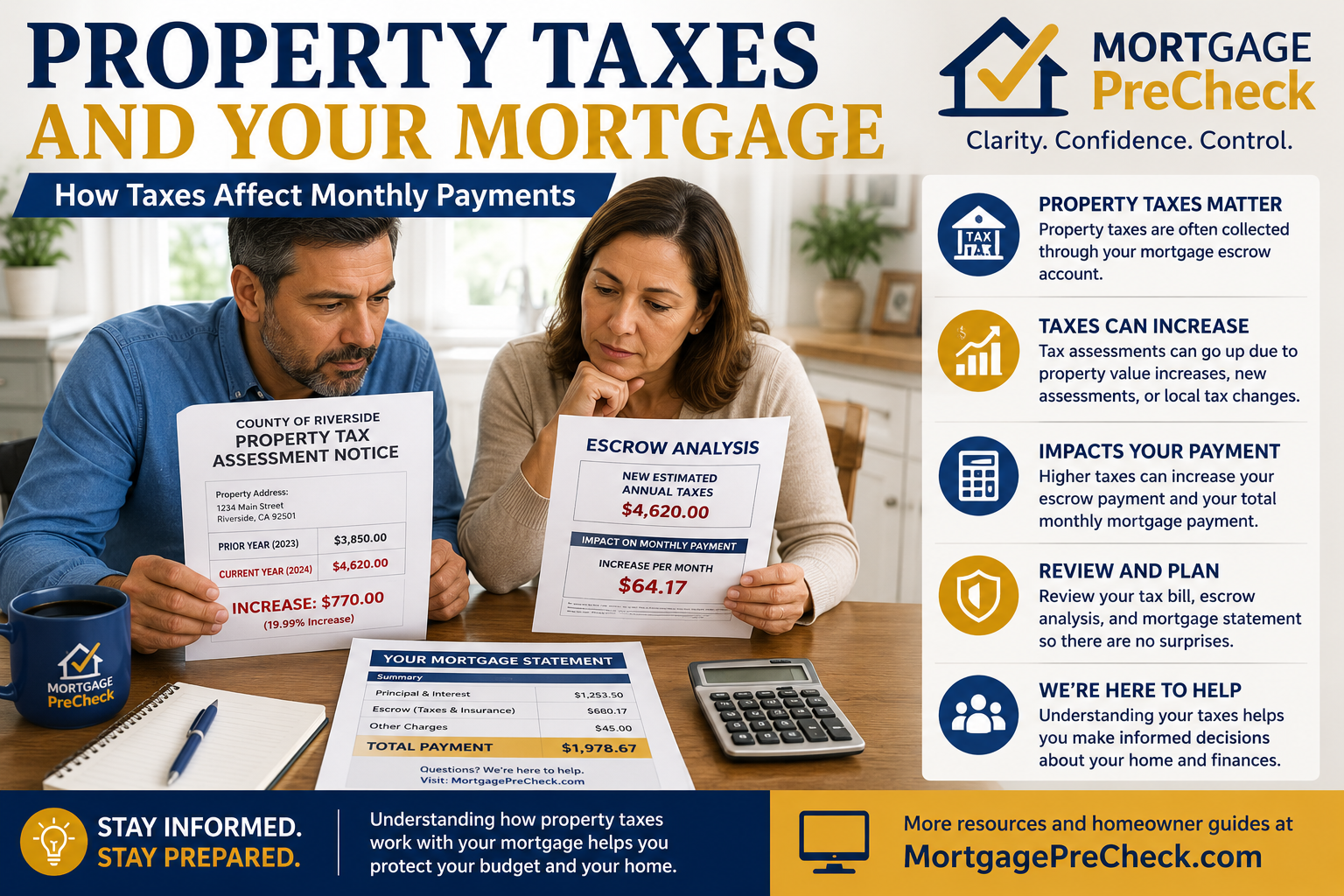
Property Taxes and Your Mortgage are closely connected when property taxes are collected through a mortgage escrow account. A change in property taxes can increase the monthly mortgage payment even when the loan’s principal and interest payment did not change.
Many homeowners first notice a property tax change when they receive an escrow analysis, a new mortgage statement, or a notice showing that the monthly payment increased. Understanding how property taxes affect a mortgage payment can help homeowners review the increase and identify the documents that explain the change.
MortgagePreCheck Tip: A property tax increase can raise the escrow portion of the monthly payment. This does not necessarily mean the interest rate or basic loan terms changed.
Property Taxes and Your Mortgage Basics
Property taxes are local taxes assessed against real property. They may be collected by a county, city, school district, or other local taxing authority.
When property taxes are included in escrow, the mortgage servicer collects money each month and uses those funds to pay the tax bill when it becomes due.
If property taxes increase, the servicer may increase the escrow payment so the escrow account has enough money to pay the next tax bill.
Why Property Taxes Can Increase
Property taxes may increase for several reasons. The cause is usually found in the tax bill, tax assessment notice, or county property records.
Common reasons property taxes increase include:
- Property value reassessment
- Local tax rate changes
- School district levies
- Special assessments
- New local bond measures
- Loss of a tax exemption
- Property improvements or additions
- Correction of a prior assessment
How Property Taxes Affect the Monthly Mortgage Payment
When property taxes are escrowed, the mortgage servicer estimates how much will be needed to pay future taxes. The servicer then divides that projected amount into monthly escrow payments.
If the tax bill goes up, the escrow projection may also go up. That can increase the total monthly mortgage payment.
The homeowner may also have to repay an escrow shortage if the prior escrow payment was not enough to cover the tax bill that was actually paid.
Escrow Shortages Caused by Property Taxes
An escrow shortage can occur when property taxes are higher than expected. If the servicer paid the tax bill and the escrow account did not contain enough money, the account may show a shortage or deficiency.
The servicer may increase the monthly payment to recover the shortage and collect enough money for the next tax cycle.
This is one of the most common reasons a property tax increase causes a noticeable mortgage payment increase.
Documents to Review First
When property taxes affect the mortgage payment, homeowners should gather the documents that show the tax amount, escrow calculation, and monthly payment change.
- Current property tax bill
- Prior year property tax bill
- Property tax assessment notice
- Annual escrow analysis
- Current mortgage statement
- Prior mortgage statement
- Payment history from the servicer
- Homeowners insurance declaration page, if escrow also changed for insurance
How to Compare Property Tax Changes
Step 1: Compare the current property tax bill with the prior year property tax bill.
Step 2: Identify whether the increase came from assessed value, tax rate, special assessment, school levy, or loss of exemption.
Step 3: Review the escrow analysis and identify the tax amount used by the servicer.
Step 4: Compare the escrow analysis with the actual tax bill.
Step 5: Review the current mortgage statement and identify how much of the monthly payment is escrow.
Step 6: Contact the servicer in writing if the escrow calculation does not match the tax documents.
Tax Assessment Notices
A tax assessment notice may show the value assigned to the property for tax purposes. This is not always the same as market value or appraised value.
If the assessed value increased, the tax bill may increase. Homeowners should review the assessment notice and confirm whether any exemption, classification, or valuation change occurred.
Some jurisdictions provide appeal procedures for property owners who believe the assessment is incorrect. Homeowners should review local deadlines carefully because assessment appeal windows may be limited.
Property Tax Exemptions
Some homeowners may qualify for tax exemptions, credits, abatements, or reductions based on local law. Examples may include homestead exemptions, senior exemptions, disabled veteran exemptions, or other local programs.
If an exemption was removed, expired, or not applied correctly, the property tax bill may increase.
Homeowners should contact the local tax assessor or treasurer to confirm whether exemptions were applied correctly.
Questions to Ask the Mortgage Servicer
- What property tax amount was used in the escrow analysis?
- Did the servicer pay the current tax bill?
- Was there an escrow shortage caused by the tax payment?
- How much of the monthly payment increase is caused by property taxes?
- Can the servicer provide a copy of the escrow analysis?
- Can the servicer provide an escrow payment history?
- Did the servicer use the correct property tax bill?
- Was the tax bill paid on time?
Questions to Ask the Taxing Authority
- Why did the property tax bill increase?
- Did the assessed value change?
- Did the tax rate change?
- Were any exemptions removed or changed?
- Were any special assessments added?
- Is there an appeal or review process?
- What is the deadline to dispute the assessment?
MortgagePreCheck Tip: The mortgage servicer usually does not set the property tax amount. The tax amount is generally determined by the local taxing authority. The servicer uses the tax bill to calculate escrow.
When Property Taxes May Require Closer Review
Property taxes may require closer review when the tax bill increased significantly, when an exemption disappeared, when the escrow analysis does not match the tax bill, or when the servicer appears to have paid the wrong amount.
Closer review may also be appropriate if the property tax increase occurred shortly after a purchase, refinance, reassessment, servicing transfer, or change in local tax rules.
Related Mortgage Education Center Articles
Why Did My Mortgage Payment Go Up?
What Is Escrow and Why Did It Increase?
Understanding Your Mortgage Statement
Additional Educational Resources
Additional consumer mortgage information is available through the Consumer Financial Protection Bureau Mortgage Resources and general legal reference materials are available through Cornell Law School’s Legal Information Institute.
MortgagePreCheck Summary
Property taxes can affect the monthly mortgage payment when taxes are collected through escrow.
If property taxes increase, the mortgage servicer may increase the escrow portion of the monthly payment and may also collect additional funds to cover a shortage.
Understanding the connection between property taxes and your mortgage helps homeowners review payment changes, compare tax bills, and identify whether the escrow calculation appears consistent with the property tax records.
|
Previous Article
Understanding Your Mortgage Statement |
MORTGAGE
EDUCATION CENTER |
Next Article
Understanding PMI |